Reading context
This article was written with AI assistance. The platform it describes was also built with AI assistance. Neither statement invalidates the engineering effort behind it.
Introduction
This is not a startup announcement. It is an engineering postmortem, an architectural retrospective, and a transparent breakdown of what happens when you build a platform with AI systems over three days.
The project started as a simple website. Within 72 hours, it had evolved into a runtime-oriented engineering platform with internationalization, dynamic SEO infrastructure, an MDX-based content system, OKLCH design tokens, AI-consumable repository metadata, and a full Lighthouse-optimized frontend. The entire codebase was co-developed with three AI systems: v0.dev for initial UI acceleration, Claude Code for repository-level engineering, and ChatGPT as a systems-thinking collaborator.
The central thesis is straightforward:
You are reading an article developed with AI assistance, about a platform developed with AI assistance, and that is not inherently wrong.
But this thesis requires a critical clarification that most AI discourse gets wrong. AI accelerated implementation. It did not replace engineering judgment. The bottleneck moved from typing code to validating systems. Supervision mattered more than prompting quantity. Architecture thinking mattered more than generation speed. And systems thinking became the single differentiator between projects that scale and projects that collapse under their own generated complexity.
This article is organized as a series of observations from the conversation logs, the engineering decisions, and the architectural evolution that happened across those 72 hours. It does not claim that AI builds platforms alone. It claims something more interesting: that engineering still matters, that reasoning quality determines output quality, and that AI-assisted development changes the role of the engineer without diminishing its importance.
Building a Platform in Three Days
The earliest conversations focused on visual direction, landing page structure, cinematic UI, motion systems, and branding. The initial scope was a marketing website with animations and a clean engineering aesthetic. Nothing unusual.
Within hours, the scope had shifted dramatically.
The project stopped being a website and started becoming a frontend systems platform. The conversation logs show a rapid escalation from visual iteration into:
- SEO architecture
- Metadata systems
- Internationalization
- MDX infrastructure
- Runtime-oriented content systems
- Structured data generation
- AI-consumable repository metadata
- LLM.txt
- Canonical URL systems
- Hreflang alternates
- Static optimization
- Lighthouse optimization
- Long-term maintainability
This transition happened organically. Each implementation revealed adjacent infrastructure that needed to exist. A landing page needed SEO. SEO needed metadata. Metadata needed localization. Localization needed routing architecture. Routing architecture needed canonical consistency. Canonical consistency needed hreflang generation. Each layer was not optional. Each layer was infrastructure.
Velocity observation
AI systems compressed what would have been a two-week engineering sprint into 72 hours. But the compression was not uniform. UI work accelerated dramatically. Infrastructure work accelerated moderately. Architectural reasoning did not accelerate at all. That remained human-led.
The engineering velocity was real. The cognitive overhead was also real. The session logs reveal repeated patterns of context exhaustion, architectural drift, regression introduction, and the constant need for re-validation. Every acceleration came with a corresponding cost.
The Human Orchestration Layer
The most important observation from the conversation logs is that the human role evolved into something fundamentally different from traditional engineering management.
The bottleneck moved from typing code to validating systems.
The human role became:
- Architecture supervisor
- Systems orchestrator
- Validation layer
- Debugging coordinator
- AI workflow conductor
- Generated code reviewer
- Architectural consistency enforcer
Prompt evolution tells the story. Early prompts were broad and visual. Within hours, prompts had become highly structured engineering specifications containing directory paths, component names, architectural constraints, and validation criteria. The project context itself gradually became a persistent engineering specification that each AI system consumed and contributed to.
The session logs reveal repeated issues that required human intervention:
- Generated code introducing regressions in unrelated parts of the system
- Metadata inconsistencies across localized routes
- Duplicated implementations of the same utility
- Invalid SEO assumptions embedded in generated code
- Performance tradeoffs introduced during optimization passes
- Overcomplicated abstractions that violated project conventions
- Partially correct implementations that needed architectural correction
- Context overflow causing mid-session drift
- Implementation drift across consecutive sessions
Each of these required engineering judgment to detect and correct. The AI systems never self-corrected these patterns. They detected nothing unusual. The human layer provided the stability that kept the project from collapsing under its own generated complexity.
Key insight
AI-assisted development amplifies both good and bad engineering decisions. Bad architecture scales faster with AI. Technical debt compounds faster. Inconsistency propagates faster. The human layer is not optional. It is the stability function that prevents runaway complexity.
The quality improvements visible in the session logs rarely came from a single perfect prompt. Quality emerged from iterative refinement, architectural correction, debugging loops, rejecting flawed generations, restructuring repositories, enforcing consistency, repeated validation, and long-context engineering discussions.
This is the human orchestration layer. It is not about writing more prompts. It is about supervising generated systems with the same rigor as hand-written code.
v0.dev and Early UI Acceleration
The first AI system engaged was v0.dev, used primarily for initial UI acceleration. The session logs show heavy early focus on layout generation, visual iteration, component scaffolding, and experimentation velocity. This phase was where the project gained its visual identity: the cinematic hero sections, the animated transitions, the engineering-focused aesthetic.
But the generated outputs required significant restructuring work. The conversation logs reveal repeated cycles of:
- Component generation
- Normalization pass
- Consistency enforcement
- Architecture restructuring
- Performance refinement
The pattern was consistent. v0.dev would generate a visually impressive component. Then the engineering work began. The generated code needed to be restructured to fit the project's architecture. Hardcoded colors needed replacement with design tokens. Inline styles needed conversion to Tailwind utilities. Animation logic needed to respect the project's Framer Motion conventions. Component APIs needed normalization.
v0.dev usage pattern
The pattern is not a criticism. It is an observation about the division of labor. v0.dev excelled at the visual exploration phase where iteration speed mattered more than architectural precision. The human role during this phase was to capture the visual direction and then normalize it into the project's engineering conventions.
The session logs also show that pure UI generation was the smallest portion of the overall engineering effort. Once the visual direction was established, the project rapidly moved beyond UI entirely. The remaining 90% of the engineering work had nothing to do with visual components.
Claude Code as Repository-Level Engineering Infrastructure
Claude Code became the primary engineering interface for the project. The session logs show it being used for repository-wide modifications at a scale that would have been impractical without automation.
The workload included:
- Repository-wide refactoring passes
- Metadata generation across all content
- SEO implementation across every route
- Internationalization content migration
- Package installation and integration
- Route generation and architecture
- Design token migration (OKLCH conversion)
- Tailwind canonical normalization
- Dynamic sitemap generation
- Robots.txt and LLM.txt generation
- MDX content system implementation
- Performance optimization passes
- Content architecture migration
- Filesystem-level engineering operations
The sessions reveal a specific pattern of interaction. Each session would begin with a structured engineering specification. Claude Code would execute the work across the repository. Then human validation would identify issues requiring correction. This cycle repeated across every major feature.
What Worked
Claude Code excelled at operations that involved repetitive modification across the entire codebase. The OKLCH design token migration, for example, required finding every hardcoded hexadecimal color across hundreds of files and replacing it with the corresponding semantic token. Manual execution would have taken days. Claude Code completed it in minutes.
Similarly, the Tailwind canonical normalization pass required scanning the entire project for arbitrary value utilities and replacing them with canonical Tailwind equivalents when available. The session logs show this being executed across dozens of files simultaneously.
Internationalization content migration was another area where Claude Code's repository-level capabilities proved essential. Moving articles from a flat structure into a locale-based directory, generating translated copies, updating routes, and fixing localized metadata was executed as a single cohesive operation.
Where It Failed
The session logs also document repeated failure modes:
-
Context exhaustion: Long sessions would degrade in quality as context windows filled. Later responses in a session were measurably less reliable than earlier ones. The project required frequent session resets and continuation summaries.
-
Architectural drift: Generated code would gradually deviate from the project's established conventions. A refactoring pass that started correctly would drift into inconsistent patterns by the end.
-
Regression introduction: Optimization passes would fix the target issue but break something unrelated. Lighthouse improvements that broke layout. OKLCH migrations that changed visual appearance. The logs show constant cycles of fix, validate, rollback, retry.
-
Duplicated logic: The same utility function would be generated in multiple locations across different sessions. Claude Code had no awareness of what it had already created in a previous session.
-
Incomplete consistency: The i18n migration required exact consistency across all localized routes. Claude Code would correctly migrate the majority of routes but miss edge cases that only emerged during human review.
-
Unstable assumptions: The AI would make assumptions about architecture that were incorrect, and those assumptions would propagate across the generated codebase until caught by human review.
Important observation
Every failure mode listed above was detected and corrected by human review. None were self-detected by the AI system. The supervision layer was not supplementary. It was essential.
The Pattern
The optimal interaction pattern that emerged was:
- Human specifies the engineering task with precise constraints
- Claude Code executes repository-wide
- Human reviews all changes systematically
- Issues are identified and corrected
- The corrected state becomes the baseline for the next cycle
This pattern mirrors pair programming but at a different scale. The AI handles the execution capacity. The human provides the stability function.
ChatGPT as Systems-Thinking Infrastructure
ChatGPT served a fundamentally different role in the project. It was used less as a code generator and more as an architecture planning environment, a systems decomposition tool, and a technical writing collaborator.
The session logs show ChatGPT being used for:
- Architecture planning and decomposition
- Platform philosophy development
- SEO architecture analysis
- Internationalization planning
- Engineering communication and storytelling
- Infrastructure planning
- Runtime systems discussion
- Platform positioning and technical writing
The key distinction is that ChatGPT interactions were about engineering decisions, not about engineering execution. The conversations focused on how the platform should work, not on writing the code that made it work.
The Living Engineering Specification
One of the most interesting patterns to emerge was how the project context itself became a persistent engineering specification. Each session with ChatGPT would begin with the accumulated context of previous sessions. The AI would reference decisions made in earlier conversations. Architecture constraints established in one session would propagate to subsequent sessions without being re-established.
This created an interesting dynamic. The conversation history became a de facto architecture document. Decisions were not written down formally. They lived in the accumulated context of the conversation threads. This worked well during the active development phase but raised questions about long-term knowledge preservation.
The Division of Labor
The AI systems formed a natural hierarchy:
| System | Role | Strength |
|---|---|---|
| v0.dev | UI exploration | Visual iteration speed |
| Claude Code | Repository engineering | Execution capacity |
| ChatGPT | System reasoning | Architecture thinking |
| Big Pickle / OpenCode | Article writing, technical storytelling, engineering communication | Recursive collaboration, meta-analysis, publishing infrastructure |
None of these systems operated independently. Each required human orchestration. The value was not in any individual AI's output. The value was in the coordinated interaction between human supervision, AI execution capacity, and AI reasoning support. In a fitting recursive turn, this very article was written by the model named Big Pickle running on OpenCode, an AI-assisted engineering interface that mirrors the same human-supervised workflow the article describes.
The sessions also reveal that the quality of AI output was directly proportional to the quality of the engineering specification provided as input. Vague prompts produced vague code. Precise, structured specifications produced production-grade implementations. The human skill that mattered most was the ability to decompose engineering problems into specifications that AI systems could execute reliably.
SEO as Runtime Infrastructure
One of the strongest patterns across the session logs is the transition of SEO from a marketing concern into platform infrastructure. This was not a deliberate architectural decision. It emerged naturally from the same force that drove every other aspect of the project: each implementation revealed adjacent infrastructure that needed to exist.
The SEO implementation covered:
- Canonical URL generation for every route
- Hreflang generation across all locale variants
- Dynamic metadata for every page type
- OpenGraph generation with proper images
- JSON-LD structured data for articles
- Dynamic sitemap.xml generation
- Robots.txt configuration
- LLM.txt for AI consumption
- Metadata consistency validation
- Crawlability optimization
- Lighthouse-driven performance refinement
The implementation philosophy was simple: SEO was treated as part of the application runtime. Every route generated its own metadata. Every article produced its own structured data. Every localized variant produced its own hreflang entry and canonical reference.
Architecture decision
SEO stopped being a marketing layer and became part of the application runtime. This is the only way to maintain correctness at scale, especially in a multilingual, content-driven platform.
Canonical URL Architecture
The canonical URL system provides a useful example of how simple requirements generate complex infrastructure. The requirement was straightforward: every page must declare its canonical URL. The implementation required:
- Environment-aware URL construction (production vs development)
- Locale-prefixed route generation
- Consistent slug handling across content types
- MDX frontmatter integration
- Hreflang alternate generation
- Cross-locale consistency validation
The session logs show multiple correction cycles around canonical URL generation. Early implementations used incorrect URL patterns. Later implementations introduced inconsistencies between locales. Each cycle required human detection and correction.
LLM.txt
One of the more unusual infrastructure decisions was the LLM.txt file. Traditional websites generate robots.txt for crawlers. This project also generates an LLM.txt file specifically designed for AI agents consuming the repository.
The file contains structured repository context that helps AI systems understand the project architecture, conventions, and available content before attempting to execute tasks. It is a machine-readable engineering specification that lives alongside the human-facing documentation.
This is a forward-facing architectural decision. The platform was designed not only for human consumption but also for AI systems that might be asked to maintain, extend, or analyze the repository in the future. The LLM.txt file, the AGENTS.md guidelines, and the structured repository conventions all serve this dual-purpose design.
Internationalization as Architecture
Internationalization was one of the most architecturally complex features implemented during the project. The session logs show it consuming a disproportionate amount of engineering attention relative to its surface-level complexity.
The Scope
The i18n implementation was not limited to content translation. It included:
- Locale-based directory restructuring
- Route architecture redesign
- Metadata localization
- Canonical URL maintenance across locales
- Hreflang generation
- Content duplication avoidance
- SEO metadata translation
- OpenGraph generation per locale
- Dynamic route generation
- Slug translation
- Cross-locale content linking
The Complexity
The architectural complexity introduced by internationalization extends far beyond translation. Each locale effectively operates as a parallel site with its own routes, metadata, SEO configuration, and content. The engineering challenge is maintaining consistency across these parallel universes without introducing drift.
The session logs reveal repeated consistency issues:
- Metadata fields translated in one locale but not another
- Canonical URLs pointing to the wrong locale
- Hreflang alternates missing entries
- Article dates diverging across locales
- Tags translated inconsistently
- Author information not localized
- OG images unresolved for non-default locales
Each issue individually was minor. Collectively, they represented a consistency debt that accumulated faster than manual correction could address.
i18n architectural lesson
Internationalization introduces architectural complexity far beyond text translation. Every metadata field, every URL, every SEO tag, every structured data entry becomes a consistency problem across N locales. Automation helps execute the migration. Human validation ensures consistency is not lost.
The pattern that emerged was to treat each locale as a first-class content system with its own complete metadata, rather than treating translation as a overlay on a primary locale. This approach doubled the content surface area but eliminated the implicit coupling that causes consistency drift.
MDX as Infrastructure
The content layer in this project started as static Markdown files. It did not stay that way for long.
MDX evolved from a file format into a runtime content system. The implementation included:
- MDX rendering pipeline with server-side compilation
- Dynamic metadata extraction from frontmatter
- Syntax highlighting via Shiki
- Custom component injection
- Code block copy buttons
- Localized content routing
- SEO-aware content rendering
- Article index generation
- Tag-based filtering
- Author-based filtering
- Dynamic OG image generation per article
- Content reuse across locale variants
The Rendering Pipeline
The MDX pipeline compiles articles server-side through next-mdx-remote/rsc, applies rehype-pretty-code for syntax highlighting and rehype-slug for heading anchors, and renders custom components through a centralized components map. Every article passes through the same pipeline, ensuring consistent rendering behavior across the entire content system.
Content as Engineering Storytelling
The most important architectural shift was conceptual. The blog stopped being a blog and became a runtime content system. Articles were not static documents. They were engineering storytelling infrastructure that participated in the platform's metadata, SEO, indexing, and AI-consumable layers.
Each article generates:
- Its own OpenGraph metadata
- JSON-LD structured data
- Dynamic OG images
- Hreflang alternatives
- Canonical URL reference
- Sitemap entries
- LLM.txt context entries
- Tag-based classification
- Author attribution with avatar
- Reading time estimates
- Share links for multiple platforms
Architecture philosophy
Treating content as infrastructure rather than as files changes how you design every layer of the platform. Metadata becomes automatic. SEO becomes deterministic. Internationalization becomes systematic. The engineering effort shifts from manual content management to content system design.
The pattern is consistent with the broader platform philosophy: every component, every page, every article should participate in the platform's metadata, SEO, and discoverability systems automatically, without manual configuration.
LLM.txt and AI-Consumable Repositories
One of the most distinctive architectural decisions in this project was designing the repository for both human and AI consumption. This is not a common practice yet, but the session logs suggest it will become increasingly important.
The Problem
AI coding agents operate on repository context. When an agent enters a repository, it needs to understand:
- The project architecture and conventions
- Available scripts and configurations
- Content organization patterns
- Code style and naming conventions
- Testing and validation practices
- Deployment and infrastructure setup
- Framework-specific configurations
Without this context, AI agents make incorrect assumptions. The session logs document exactly this failure pattern: Claude Code repeatedly generated code that violated project conventions because the conventions were not machine-readable.
The Solution
The project implemented several mechanisms to make the repository AI-consumable:
-
AGENTS.md: A root-level file containing agent-specific instructions, modeled after the Next.js convention documented at
/docs/app/guides/ai-agents. This file tells AI agents how to operate in this specific repository. -
LLM.txt: A generated file providing structured repository context for large language model consumption. It includes architecture overview, content organization, conventions, and available tooling.
-
Structured repository conventions: Consistent directory organization, predictable naming patterns, and enforced code conventions that make the repository navigable by AI systems.
-
Metadata-driven content: Every article and page produces machine-readable metadata that AI systems can consume without parsing unstructured content.
-
Canonical URL infrastructure: AI systems can reliably generate links and references because the platform provides deterministic URL patterns.
AI-consumable repository layers
The repository exposes structured context through multiple machine-readable channels.
Why This Matters
The architectural significance of AI-consumable repositories extends beyond convenience. As AI coding agents become more capable, they will increasingly be asked to maintain and extend existing codebases. Repositories designed for AI consumption will require less context transfer, produce fewer incorrect assumptions, and integrate more seamlessly into AI-assisted workflows.
This is not a futuristic concern. The session logs demonstrate that context loss across sessions was one of the most significant sources of engineering friction. AI systems could not remember what they built in a previous session. Structured repository metadata reduces this problem by providing a persistent context layer that survives session boundaries.
Forward-looking architecture
The platform was designed not only for humans. It was designed for AI systems consuming repositories and content. This dual-purpose design is a deliberate architectural bet that AI-assisted engineering workflows will become the dominant mode of software development.
Performance and Lighthouse Optimization
The session logs contain repeated cycles of performance optimization driven by Lighthouse audits. This was not a one-time optimization pass. It was an iterative engineering discipline that persisted across the entire development timeline.
The Optimization Cycles
Each cycle followed the same pattern:
- Run Lighthouse audits (desktop and mobile)
- Document all issues found
- Apply fixes incrementally
- Re-run Lighthouse after each optimization batch
- Iterate until scores significantly improve
- Document remaining bottlenecks
This cycle repeated multiple times across the project. Each pass would improve scores in one area while potentially introducing regressions in another. The logs show the constant tension between performance optimization and other concerns:
-
Visual design vs performance: Framer Motion animations needed to be preserved for users but disabled for crawlers and no-JS visitors. The solution was to disable animations by default and enable them only when JavaScript is available.
-
Metadata vs payload: Rich metadata improves SEO but increases page payload. The solution was to generate metadata server-side and minimize client JavaScript.
-
Images vs LCP: High-quality images improve visual appeal but degrade Largest Contentful Paint. The solution was preloading LCP images and converting to modern formats.
Specific Optimizations Applied
The session logs document a broad range of optimizations:
- Font loading optimization (swap display, preload)
- Image optimization (WebP/AVIF conversion, proper sizing, lazy loading)
- Client component reduction (moving logic to server components)
- Bundle size reduction (code splitting, tree shaking)
- Render-blocking resource elimination
- Framer Motion performance tuning
- Layout shift prevention (explicit dimensions, font metrics)
- Metadata and SEO optimization
- Semantic HTML improvements
- Accessibility compliance
- Core Web Vitals targeting (LCP, FID, CLS)
- Caching strategy implementation
- Critical CSS inlining
- JavaScript deferment for below-fold content
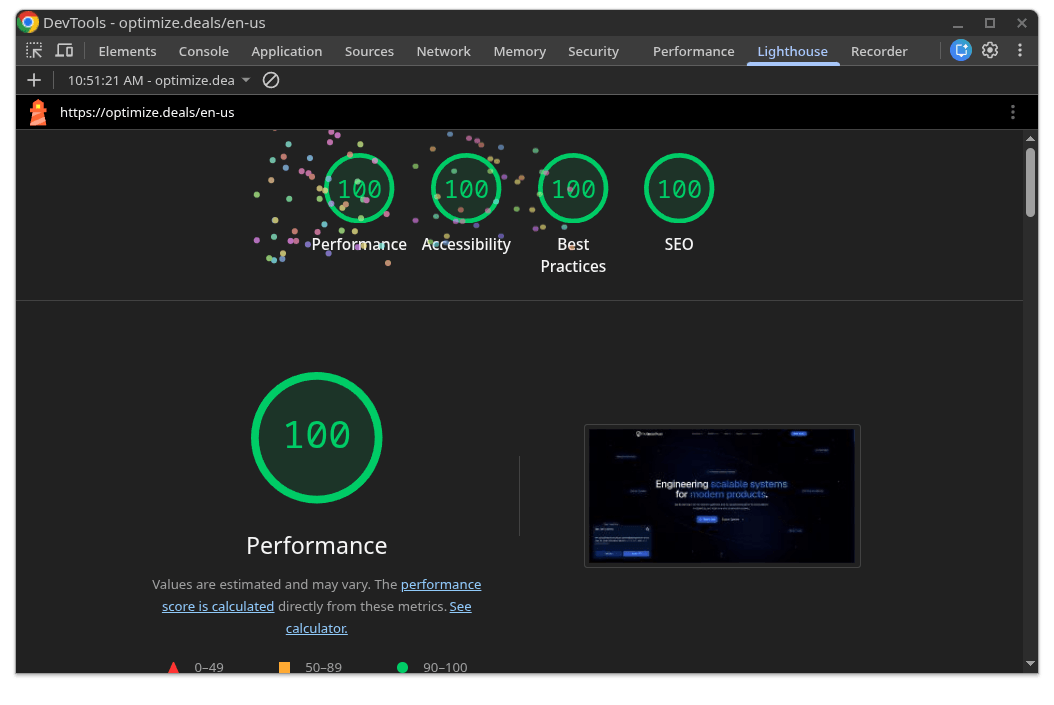
Lighthouse score trajectory
The Engineering Lesson
Performance optimization in an AI-assisted project is not different from performance optimization in a traditional project. The same engineering discipline applies. The difference is that AI can execute optimization passes faster, which means the iteration cycle compresses. But the engineering judgment required to evaluate tradeoffs and validate correctness remains human-led.
The session logs show that optimization was not a final polishing step. It was integrated into the development cycle from the beginning. Every feature implementation included a performance validation pass. Every metadata change considered Lighthouse impact. This discipline was enforced by the human layer, not by the AI systems.
Cognitive Debt vs Cognitive Amplification
This section addresses what may be the most important question about AI-assisted engineering: does AI reduce engineering quality, or does it amplify engineering capability? The answer, based on the session logs, is that it depends entirely on how the AI is used.
Passive AI Usage
Passive AI usage follows a pattern that produces negative outcomes:
- Accept generated code without review
- Assume correctness based on confidence
- Skip validation because it feels correct
- Avoid understanding generated implementations
- Delegate architectural decisions to the AI
- Trust that consistency is maintained automatically
This pattern results in:
- Architectural drift that compounds across sessions
- Technical debt that accumulates faster than human correction
- Inconsistency that propagates silently
- Hallucinated APIs and configurations
- Overcomplicated abstractions that nobody fully understands
- Degraded debugging capability (harder to debug code you did not write)
- Shallow understanding of the system
The session logs contain examples of all these failure modes. They are not theoretical.
Active AI Collaboration
Active AI collaboration follows a fundamentally different pattern:
- Use the AI as an execution layer, not a decision layer
- Review generated code with the same rigor as human-written code
- Validate architectural consistency after every generation pass
- Maintain thorough understanding of the entire system
- Delegate implementation, not architecture
- Treat AI output as a draft that requires engineering review
- Use AI for exploration without committing to generated solutions
- Maintain human ownership of architectural decisions
This pattern results in:
- Dramatically accelerated implementation timelines
- Maintained architectural integrity
- Consistent code conventions
- Thorough validation coverage
- Deeper understanding (validating code requires understanding it)
- Better debugging capability
- Accelerated learning (reading AI-generated code teaches patterns)
The Key Insight
The session logs demonstrate a clear correlation: projects that maintain human ownership of architecture decisions succeed with AI assistance. Projects that delegate architecture to AI systems accumulate debt faster than they can correct it.
Cognitive debt warning
Bad architecture scales faster with AI assistance. Technical debt compounds faster. Hallucinations propagate faster. Inconsistency compounds faster. AI amplifies the trajectory of a project. It does not determine the direction. The human layer determines the direction.
The distinction between amplification and debt is not determined by the AI system. It is determined by the engineering practices surrounding its use. Active supervision, thorough validation, and architectural ownership are not optional. They are the defining practices that separate successful AI-assisted engineering from generated chaos.
Open Source and Transparent Engineering
The repository for this project is open source. The articles are plain text in git. The conversation logs that informed this article are available for inspection. This transparency is not accidental. It is an architectural decision that aligns with the platform's engineering philosophy.
Why Open Source Matters for AI-Assisted Projects
Open source repositories provide several advantages in the context of AI-assisted development:
-
Context availability: AI systems can inspect the entire codebase without access restrictions. This improves the quality of AI-generated code by providing complete context.
-
Pattern reference: Other projects can learn from the patterns established here. The MDX component showcase, the i18n migration approach, and the SEO infrastructure are all reusable patterns documented through code.
-
Validation surface: Open repositories invite scrutiny. Bugs, inconsistencies, and architectural issues are more likely to be identified when the code is visible.
-
AI training data: Open source code improves the quality of AI training data. Projects that contribute open source code are indirectly improving the tools they depend on.
The Article as Platform Architecture
This article itself is part of the platform architecture. It is an MDX file in the same content system as every other article. It generates metadata, structured data, OG images, and sitemap entries automatically. It participates in the i18n system and will be translated alongside other content.
This is intentional. The article does not describe the platform from outside. It operates within the platform. This creates a recursive relationship where the medium and the message are the same system.
Final Reflections
AI-assisted engineering dramatically compressed the implementation timeline for this platform. What would have required multiple engineering sprints was executed in three days. The codebase is production-grade. The Lighthouse scores are 98+/100. The SEO infrastructure is comprehensive. The i18n system supports multiple locales. The content system is extensible and maintainable.
None of this happened automatically.
The following observations summarize what the session logs reveal about AI-assisted engineering:
AI accelerates implementation, not architecture. The AI systems in this project executed tasks faster than any human could. But they did not make architectural decisions. Architecture remained human-led across every phase of the project. When the human layer was removed (context exhaustion, session boundaries, fatigue), architectural drift appeared immediately.
Validation is the bottleneck. The limiting factor in this project was not code generation speed. It was validation throughput. Every generated change required human review. Every optimization required human verification. Every migration required human consistency checking. The AI systems could generate faster than humans could validate. This imbalance is the fundamental constraint of current AI-assisted development.
Reasoning quality determines output quality. The session logs show a clear relationship between the precision of engineering specifications and the quality of AI output. Vague specifications produced unreliable code. Precise, structured specifications produced production-grade implementations. The human skill that differentiated successful sessions from failed sessions was the ability to decompose problems into executable specifications.
Supervision is not optional. Every failure mode observed in the session logs was detected and corrected by human review. AI systems did not self-correct. They did not detect inconsistency. They did not recognize architectural drift. The human supervision layer was not supplementary. It was the essential stability function that prevented the project from collapsing under its own generated complexity.
Systems thinking is the differentiator. The engineers who will thrive in AI-assisted environments are not the ones who write the best prompts. They are the ones who understand systems: how components interact, how data flows through the architecture, how metadata propagates, how consistency is maintained across distributed systems. AI can execute. It cannot yet reason about system-level behavior. That capability remains human-exclusive.
What Comes Next
The trajectory of AI-assisted engineering is clear. Implementation speed will continue to increase. The cost of generating code will continue to decrease. The bottleneck will shift further toward validation, architecture, and systems thinking.
The future advantage belongs to engineers capable of:
- Orchestrating AI systems effectively
- Validating generated code aggressively
- Reasoning deeply about system behavior
- Designing architectures that remain stable at high generation velocity
- Collaborating intelligently with AI systems without delegating judgment
The author of this article, the builder of this platform, and the orchestrator of these AI systems is an engineer named Bruno Silva. Every line of code in this repository was either written or directly supervised by him. The AI systems were tools. He was the engineer.
This article was written with the assistance of Big Pickle, the model running OpenCode, an AI-assisted engineering interface. The same systems that built the platform helped write about building it. That recursive collaboration across Claude Code, ChatGPT, v0.dev, and OpenCode is itself a reflection of the engineering philosophy this article describes.
Final thought
This article was written with AI assistance. It was not written by AI. The distinction is critical. AI augmented the writing process. It did not replace it. The engineering judgment, the architectural decisions, and the supervision that made this project possible were human. They remain human. And the most important skill in AI-assisted engineering is not prompting. It is knowing what to build and why.
You can explore the full repository, the conversation logs, and the complete article history at github.com/optimizedeals/optimizedeals. The repository is open source and designed for both human and AI consumption.