When people look at applications like Google Drive, they usually see a single product.
A clean interface. A search bar. A sidebar. Some buttons. A few integrations.
Simple.
But from an engineering perspective, that screen is rarely "just one frontend".
What looks visually seamless to users is often the result of dozens of independent systems, teams, deployment pipelines, APIs, runtime integrations, shared platforms, and organizational boundaries operating together in real time.
That is the hidden reality of modern frontend engineering.
Consider the user-facing perspective:
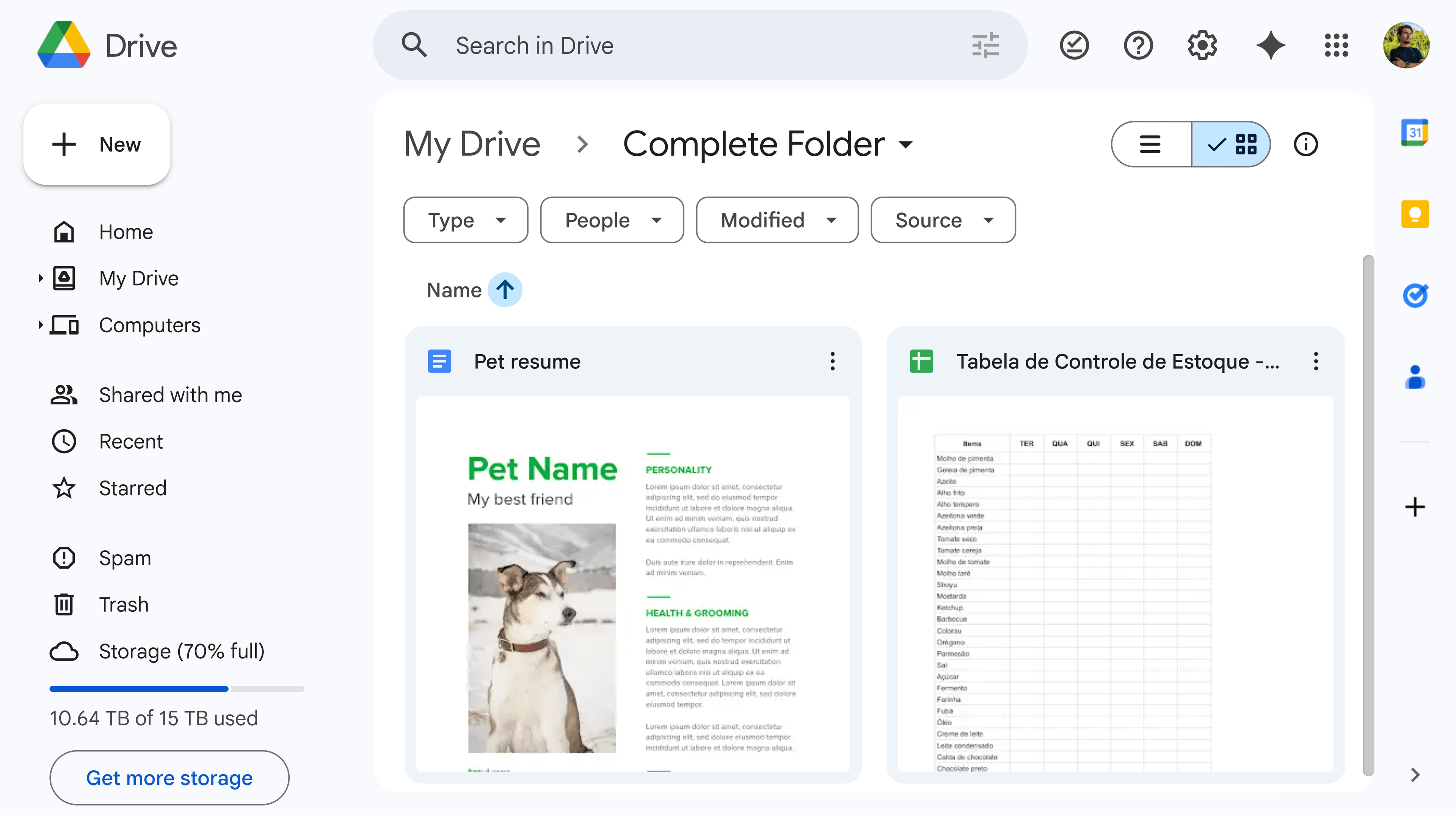
At a certain scale, frontend architecture stops being "just UI".
It becomes infrastructure.
The Illusion of a Single Application
Take a closer look at a modern enterprise platform.
Even within a single screen, you may find:
- authentication systems
- AI integrations
- cross-product navigation
- notification systems
- search infrastructure
- billing domains
- storage management
- embedded applications
- feature platforms
- analytics layers
- shared design systems
- runtime containers
Each one potentially owned by different engineering teams.
Each one evolving independently.
Each one deployed on different release cycles.
Yet the final experience must feel cohesive.
That cohesion is one of the hardest engineering problems modern organizations solve.
If Everything Was a Frontend Monolith
Now imagine building a platform like this as a single frontend monolith.
One repository. One deployment pipeline. One massive codebase. One release process.
At first, this sounds simpler.
And in early-stage products, it often is.
But as organizations scale, the frontend monolith starts creating organizational friction.
Typical Problems
1. Release Bottlenecks
A small change in the sidebar could block the deployment of search features.
An unfinished experimental feature could delay a critical billing fix.
Every team becomes coupled to the same deployment process.
The larger the organization becomes, the slower the platform moves.
2. Coordination Overhead
Teams begin stepping on each other's toes:
- merge conflicts increase
- ownership becomes blurry
- frontend domains overlap
- deployments require synchronization
- unrelated teams become dependent on each other
Eventually, the organization spends more time coordinating than shipping.
3. Cognitive Load Explosion
New engineers must understand:
- the entire repository
- all architectural conventions
- every dependency relationship
- unrelated product domains
The frontend becomes too large for any single team to reason about safely.
4. Risk Amplification
A deployment affecting one small feature now risks breaking the entire platform.
Rollback procedures become dangerous.
Release confidence decreases.
Innovation slows down because organizational fear increases.
Microservices Solved Part of the Problem
Backends experienced this pain years ago.
That is one of the reasons microservices emerged.
Instead of a single backend monolith, organizations began decomposing systems into smaller services:
- authentication services
- billing services
- search services
- notification services
- analytics services
Each independently deployable.
Each owned by different teams.
This dramatically improved organizational scalability.
But something interesting happened.
The backend evolved.
The frontend did not.
Many organizations ended up with highly distributed backend systems connected to a giant frontend monolith.
That created a mismatch.
The organizational architecture had evolved. The frontend architecture had not.
Micro Frontends: Extending Distributed Systems Into the UI
Micro frontends emerged as a response to this mismatch. (Micro Frontends)
The core idea is relatively simple:
Instead of treating the frontend as a single application, treat it as a composition of independently owned frontend domains.
This changes how organizations think about UI systems.
The frontend becomes a platform.
Not just an application.
A Modern Frontend Platform Is Often Runtime Composition
At scale, many frontend ecosystems start looking more like distributed runtime systems than traditional websites.
Different product surfaces may be:
- loaded dynamically
- mounted independently
- deployed separately
- composed at runtime
- federated through shared shells
- connected through platform APIs
- isolated by domain ownership
This is why concepts like:
- Module Federation
- Runtime Composition
- Federated Routing
- Platform Shells
- Shared Design Systems
- Edge Composition
- Web Fragments
- Embedded Applications
have become increasingly important in modern frontend engineering. (LinkedIn)
The engineering perspective reveals what the interface conceals:
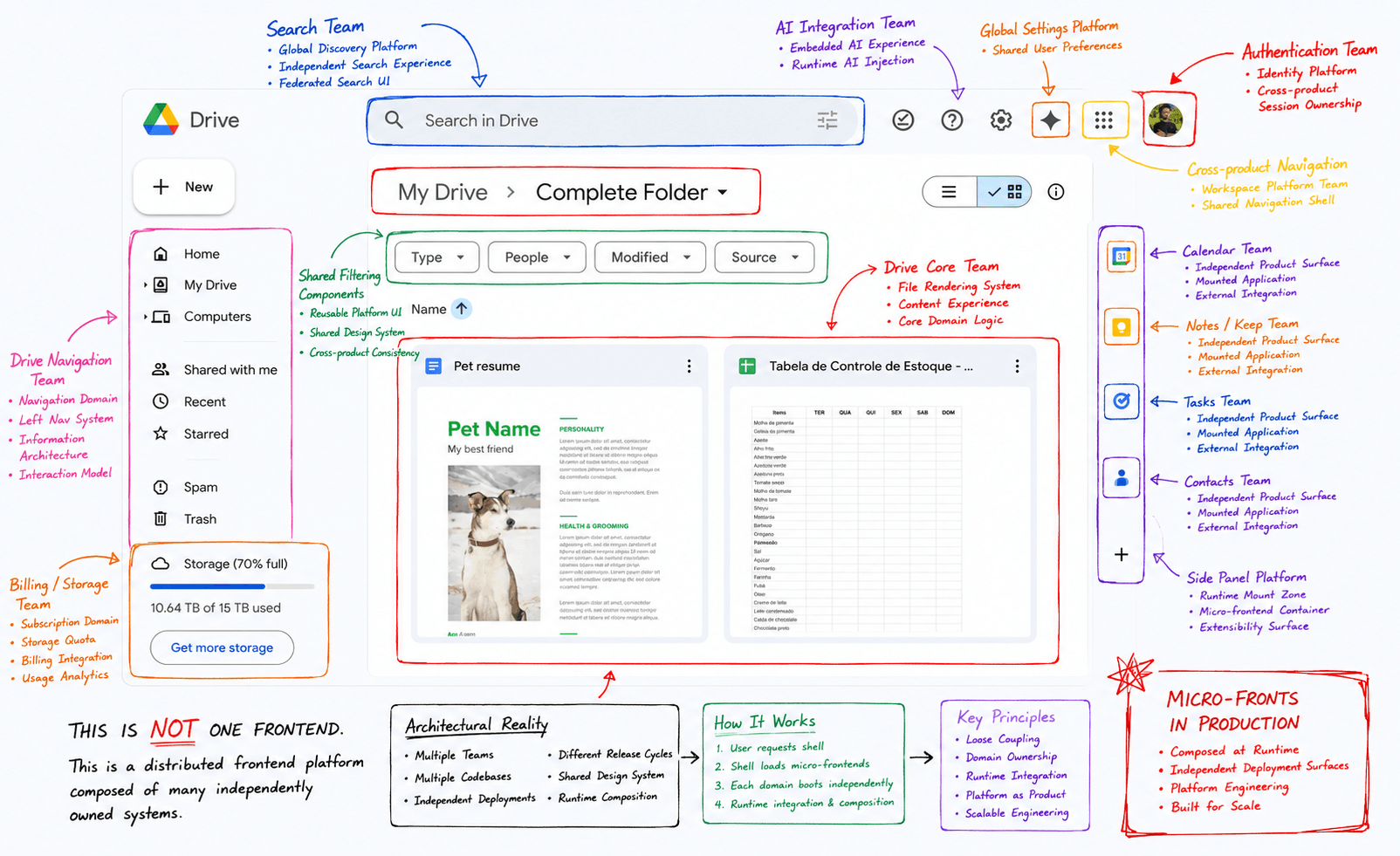
The annotations are speculative and educational, not an exact representation of Google's internal architecture. However, they reflect the type of distributed ownership patterns commonly found inside large-scale frontend ecosystems.
Conceptual analysis
These annotations are an educational exercise in architectural reading — identifying the likely team boundaries, platform layers, and runtime integrations concealed behind a cohesive interface. They are not a statement about Google's actual internal implementation.
Important Clarification About Google
It is important to clarify something:
This article is not claiming that Google Drive itself is literally implemented using a classic "micro frontend architecture".
Google is known for heavily leveraging monorepos and large-scale internal platform tooling. (Medium)
In reality, large organizations often combine multiple architectural strategies simultaneously:
- monorepos
- internal platform frameworks
- federated ownership
- embedded surfaces
- runtime integrations
- shared infrastructure layers
- internal UI platforms
The point of this analysis is conceptual.
When experienced engineers look at complex applications, they naturally begin identifying organizational boundaries hidden inside the interface.
The UI becomes a map of engineering ownership.
The Trade-Offs Nobody Talks About Enough
Micro frontends are not magic.
They solve organizational scaling problems, but they also introduce architectural complexity. (DEV Community)
This is where many discussions become overly simplified.
Benefits
- independent deployments
- clearer ownership boundaries
- faster organizational scalability
- team autonomy
- improved domain isolation
- parallel development
- incremental modernization
- reduced coordination bottlenecks
Costs
- runtime complexity
- dependency management
- shared state orchestration
- design consistency challenges
- performance risks
- monitoring complexity
- duplicated dependencies
- integration overhead
- cross-team governance problems
Sociotechnical Architecture
Micro frontends are fundamentally sociotechnical architecture. (InfoQ) They are as much about organizational structure as they are about technology.
Conway's Law Is Always There
One of the most fascinating aspects of frontend architecture is that interfaces often mirror organizational structure.
A platform with dozens of engineering teams naturally starts evolving toward distributed ownership models.
Not because architects arbitrarily decided so.
But because organizational scale eventually forces architectural decomposition.
This is Conway's Law in practice.
Large organizations rarely become distributed because they want complexity.
They become distributed because centralized ownership eventually stops scaling.
Frontend Architecture Is Becoming Infrastructure Engineering
This is the deeper shift happening in the industry.
Frontend engineering is no longer just about building screens.
Modern frontend systems increasingly involve:
- distributed runtime orchestration
- deployment topology
- shared platform governance
- organizational scalability
- edge rendering
- streaming architectures
- runtime dependency management
- cross-team contracts
- AI-assisted interfaces
- composable platform systems
The frontend is becoming infrastructure.
And the companies building the most sophisticated products in the world increasingly treat it that way.
Final Thought
The most interesting part of modern frontend systems is that users should never notice any of this.
The better the engineering becomes, the more invisible the complexity feels.
That is the paradox.
A truly scalable frontend platform hides enormous architectural sophistication behind an interface that feels effortless.
And sometimes, all it takes is looking carefully at a single screen to realize how many systems are quietly working together underneath it.