Prologue
Most public conversation about AI still orbits the model.
Which checkpoint scores higher on MMLU. Which release has the longer context window. Which lab shipped a more aggressive post-training pipeline this quarter. The leaderboard frames the discourse as if intelligence were a property you procure by signing a usage agreement.
That framing collapses the moment you ship something real.
After enough quarters spent in production environments (answering tickets, settling claims, drafting code, routing financial transactions, summarizing patient histories), a different picture emerges. The model is not where the system lives. The model is a stateless inference function plugged into a much larger apparatus that decides what it sees, when it sees it, and what to trust about what comes back. That apparatus is a data system, and it is the actual product.
Core observation
In real-world AI products, the model is rarely the primary source of intelligence. The system around it is. Treating the model as the product is the most expensive mistake teams make in the first six months of an AI initiative.
The quality of a deployed AI system tracks far more tightly with:
- how information is structured at rest and in motion
- how context is retrieved, ranked, and pruned
- how memory is preserved across turns, sessions, and tenants
- how ambiguity is reduced before inference, not after
- how tools and side effects are orchestrated
- how failure modes are detected, contained, and recovered
The LLM is, in nearly every serious deployment, the final inference layer sitting on top of a substantially larger architecture. Reason about it that way and the design problem clarifies itself.
The Industry Is Optimizing the Wrong Variable
Most teams begin with the wrong question:
"Which model should we use?"
The honest answer, almost always: it matters far less than you think. A weak retrieval pipeline wired into the strongest available model still produces mediocre, unreliable output. A carefully constructed retrieval and ranking stack feeding a mid-tier model will outperform it on most domain-specific tasks, often by a wide margin, and almost always at a fraction of the cost.
The reason is structural. An LLM has no privileged access to your business. It does not know your schema, your policies, your customers, your inventory, your incidents, or what changed yesterday. It only knows what you place inside its context window at inference time. Every meaningful product decision compounds upstream of that.
We thought we had a model problem. We had a data problem with a model on top of it.
The skill ceiling has quietly shifted. Five years ago, the discriminating capability was training. Three years ago, it was prompting. Today it is retrieval, context engineering, and the runtime that orchestrates them.
Context Is the Real Product
The most persistent misconception about retrieval-augmented generation is that it is a database lookup with extra steps. It is not. Retrieval is a reasoning infrastructure problem, and once you treat it as one, the engineering work begins to look much more like search, ranking, and distributed systems than like prompt design.
A production-grade AI system is continuously deciding, on every request:
- what information is relevant to the current intent
- what information is irrelevant despite being topical
- what information conflicts with other retrieved information
- what information is stale and must be re-fetched from source
- what information should be prioritized in the context window
- what information should never reach inference at all (PII, expired policies, draft documents, other tenants' data)
These are not prompt-engineering decisions. They are runtime data decisions, and they determine almost everything downstream. The model becomes a consumer of the system's judgment, not a substitute for it.
Where hallucinations actually come from
In the vast majority of enterprise AI failures we have audited, hallucinations were not caused by the model. They were caused by the retrieval and ranking layers feeding it incomplete, contradictory, or stale context. The model was answering faithfully, but to the wrong inputs.
If a model is confidently wrong, ask first what it was shown. The answer is almost always more interesting than the inference.
RAG Is Primarily a Data Organization Problem
Most of what makes a RAG system good (or bad) happens long before a query is ever issued. The interesting engineering lives in the ingest path, the chunking strategy, the indexing topology, and the freshness guarantees, not in the call to the model.
A robust retrieval system is best understood as a layered architecture, each layer making decisions that constrain the next:
| Layer | Responsibility | Failure mode when neglected |
|---|---|---|
| Ingestion | Normalize sources, extract structure, attach provenance | Garbage downstream that no model can salvage |
| Chunking | Preserve semantic continuity and reference integrity | Logically incomplete retrieval units |
| Embeddings | Project content into a searchable semantic space | Topically similar but operationally wrong hits |
| Indexing | Make retrieval fast, filtered, and multi-tenant safe | Latency spikes, cross-tenant leakage |
| Retrieval | Compose hybrid queries under constraints | Recall gaps and false positives |
| Ranking | Resolve relevance under ambiguity and conflict | The model picks the loudest, not the truest |
| Memory | Preserve and retrieve cross-turn and cross-session state | Amnesiac agents, repeated work, lost intent |
| Tool orchestration | Mediate side effects and external state | Unsafe actions, partial failures, replay bugs |
| Observability | Make every decision in the pipeline inspectable and replayable | Silent degradation that nobody can debug |
Each row is its own subsystem with its own SLOs. Each row determines what the next can do. The model, the layer most teams obsess over, sits at the very end and inherits the quality of everything above it.
A useful heuristic
If a regression appears at inference time, suspect retrieval first. If retrieval looks correct, suspect chunking. If chunking looks correct, suspect ingestion. The model is the last place a bug is introduced, and almost the last place worth looking.
Why Bigger Context Windows Do Not Save You
A recurring belief is that ever-larger context windows make retrieval obsolete. Just stuff the documents in and let the model figure it out.
This is wrong in a non-obvious way.
Long context introduces a different and arguably worse class of problems:
- Attention dilution. Most transformer architectures still exhibit measurable degradation on facts buried in the middle of very long contexts. The "lost in the middle" effect has been reproduced across model families.
- Token economics. Inference cost scales with input tokens. A million-token prompt on every request is not an architecture, it is an invoice.
- Latency. Prefill time grows with context length. Interactive applications cannot afford to pay it on every turn.
- Noise injection. Indiscriminately included context introduces contradictions, distractors, and outdated material the model has to actively ignore, and often does not.
- Cache inefficiency. Long, unstructured contexts evict each other, defeating the prompt-caching strategies that make production economics viable.
- Eval brittleness. Outputs become harder to attribute to specific evidence. You lose the ability to say "the answer came from this chunk," which destroys auditability.
The dominant failure mode of naive long-context designs
Systems that indiscriminately push large amounts of content into a long context window almost always reduce precision instead of improving it. They look impressive in demos. They degrade quietly in production.
The problem was never how much context the model can hold. The problem is constructing the right context: small, dense, current, attributed, and free of contradictions. A 200k-token window is not an excuse to skip the retrieval system. It is, at best, a more forgiving target for one.
Chunking Is a Hidden Intelligence Layer
Chunking gets discussed less than it deserves, partly because it looks mechanical. It is not. Chunking is where you decide what a retrievable unit of meaning is in your domain, and that decision propagates through every query the system ever serves.
Naive systems split on:
- character or token count
- paragraph boundaries
- fixed-size sliding windows
These work tolerably for homogeneous prose. They fail badly for almost everything else. A legal clause cuts mid-reference. A code function gets separated from its imports. A medical note loses the dosage from the condition it belongs to. A policy document is split across the exception that makes the rule applicable.
When the retrieved unit is logically incomplete, the model is forced to infer the missing pieces. Inference under missing premises is exactly the regime where hallucinations are generated.
Better chunking strategies in production tend to share a few properties:
- Structure-aware. They respect the document's own boundaries (sections, clauses, functions, table rows) instead of imposing a uniform window.
- Reference-preserving. When a chunk depends on a definition, a header, or an upstream identifier, that context is co-located or duplicated. Redundancy is cheaper than incoherence.
- Multi-resolution. The same source is indexed at several granularities (sentence, paragraph, section), and retrieval picks the level that fits the query. Coarse for orientation, fine for precision.
- Stable across revisions. Chunk boundaries are anchored to the document's semantic structure so that an unrelated edit does not invalidate the entire index.
Bad chunking forces the model to guess. Good chunking gives it self-contained, dependency-complete units. Most of the production wins attributed to "better prompting" are, on inspection, better chunking.
Embeddings Alone Are Not Retrieval
Vector search is foundational, but semantic similarity is not semantic correctness. Two passages can sit close in embedding space and still be operationally incompatible. The system has to know the difference.
A few of the failure modes show up repeatedly:
| Query | Semantically similar, but wrong |
|---|---|
| Current API version | Deprecated API documentation from two years ago |
| Production deployment runbook | Staging-only experimental procedure |
| Pricing as of this quarter | Historical pricing notes from an archived plan |
| Security policy for customers | Internal-only red-team configuration |
| Refund rules for region A | Refund rules for region B with similar phrasing |
| Latest incident postmortem | An older, superficially similar incident |
Cosine distance has no opinion about which one is current, authoritative, in-scope, or permitted. That opinion has to be supplied by the retrieval system itself, through composition:
- Vector similarity for semantic recall
- Lexical / BM25 search for terms the embeddings flatten (identifiers, version strings, error codes)
- Metadata filtering for tenancy, time, region, document status, access tier
- Recency scoring for inherently time-sensitive corpora
- Graph relationships for entities, references, and dependencies between documents
- Authorization filters applied before retrieval, never after
- Cross-encoder reranking to apply heavier judgment to the top-k
The retrieval pipeline is a composition, not a primitive. Treating "embeddings + vector DB" as a complete answer is the single most common architectural error in early-stage AI systems. It works in the demo. It collapses on the first day a user asks something the embedding alone cannot disambiguate.
A Reference Topology
A modest, production-shaped retrieval and inference pipeline tends to look something like this, independent of which model or vector store sits inside the boxes:
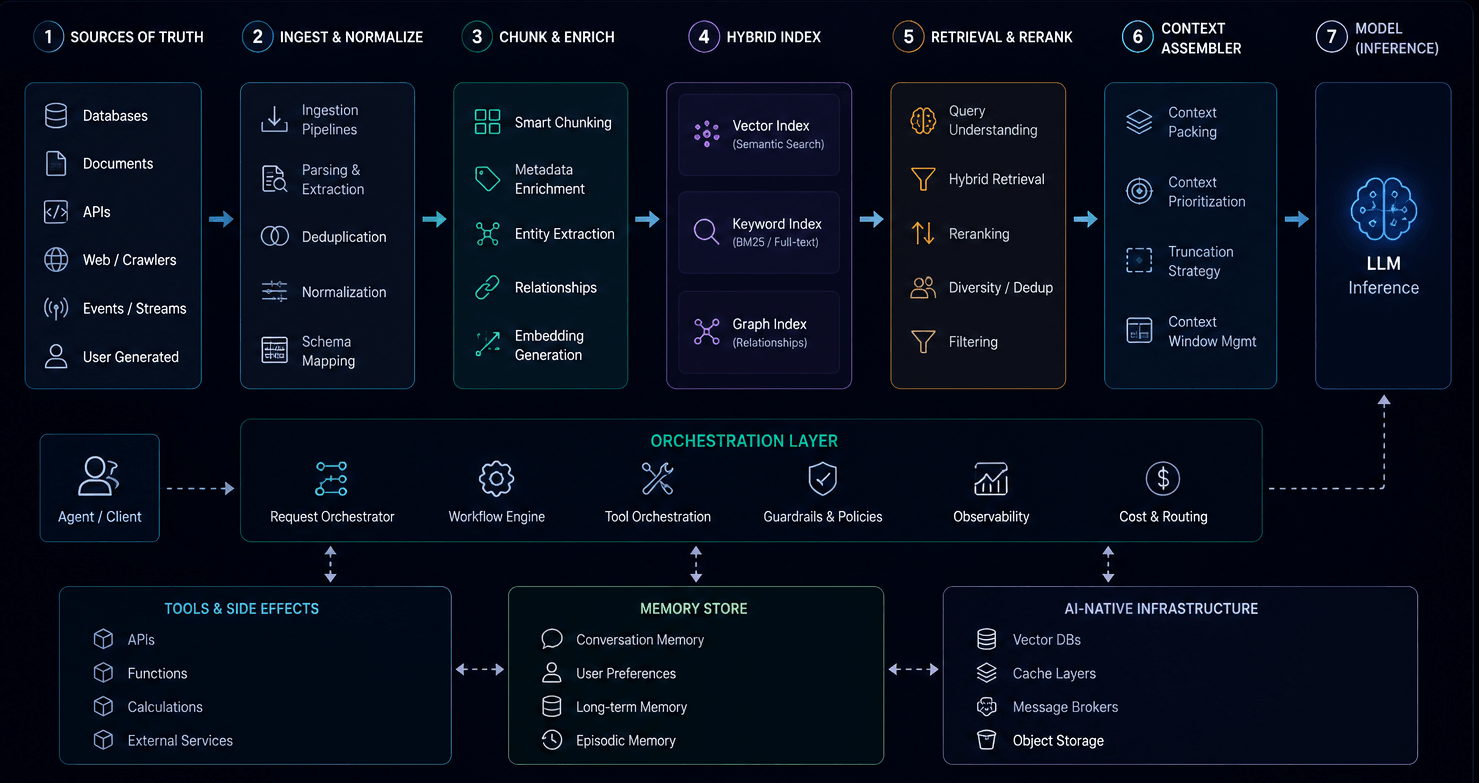
Notice how much sits before, around, and beside the model. The model is one box among ten. The interesting failure modes (staleness, leakage, latency, cost, hallucination) all originate in the boxes that do not say "model."
Tool Calling Reframes the Whole Stack
The shift from monolithic chat completion to tool-using agents is not a UX update. It is an architectural inversion.
In a tool-using design, the model is no longer expected to contain knowledge. It is expected to act on knowledge: query systems, validate state, perform writes, coordinate workflows. The product is no longer "a chatbot wrapped around a model." It is a distributed execution environment in which the model plays the role of a planner and interpreter.
That changes what the model is responsible for, and what the system around it must guarantee:
Authoritative state lives elsewhere
The model defers to databases, search indexes, and APIs for ground truth. It does not memorize what can be queried.
Workflows become first-class
Multi-step tasks are orchestrated as graphs of tool calls, with retries, compensations, and idempotency keys, not as one long prompt.
Authorization moves into tools
Permissions are enforced by the tool layer, not the prompt. The model cannot leak what it cannot reach.
Latency budgeting is per-call
Each tool call has its own latency profile. Orchestration must parallelize, cache, and time-box at the call graph level.
Schemas are the new prompts
Tool definitions (names, descriptions, JSON schemas) become the highest-leverage surface in the system. They are the contract the model reasons against.
Failure is structured
Tools return typed errors. The orchestrator decides whether to retry, fall back, ask the user, or abort, instead of letting the model improvise.
Once you adopt this view, an AI application is no longer a thin shell around an inference endpoint. It is a workflow engine with a probabilistic planner. The most consequential engineering happens in the contract between the planner and the rest of the system: schema design, error taxonomies, idempotency, observability, replay.
This is the territory that platform engineering teams already know. The good news is that decades of distributed-systems practice transfer directly. The bad news is that teams who have not built distributed systems before tend to relearn those lessons the expensive way.
The Real Problem Is Ranking
Most retrieval systems fail not because they retrieve nothing relevant, but because they retrieve too much that is plausibly relevant. The model is then handed ten chunks where only two contain the actual answer, and asked, implicitly, to identify which is authoritative.
That implicit decision is where systems become unstable. The same query, hours apart, can land on different chunks and produce different answers. Users experience this as the model being "moody." It is not moody. It is unranked.
Ranking is its own discipline:
First-stage recall
Cast a wide net with a hybrid query (vector + lexical + filters) to assemble a candidate set. Optimize for recall, not precision. You can throw things away later; you cannot recover what you never retrieved.
Feature-based scoring
Score each candidate against signals the embedding cannot see: freshness, authority, document status, prior user feedback, click-through, source reliability, regional applicability.
Cross-encoder reranking
Apply a heavier model (typically a cross-encoder) to the top-k candidates. Cross-encoders read the query and the candidate jointly, which is dramatically more accurate than the bi-encoder used for initial retrieval.
Diversity and de-duplication
Collapse near-duplicates and enforce coverage across sub-topics so the context window is not consumed by ten near-identical chunks of the same passage.
Budgeted assembly
Fit the final set into a token budget that reserves room for system instructions, tool definitions, prior turns, and the response itself. Truncation is a design decision, not an afterthought.
A principle worth internalizing
Retrieval determines what the model can see. Ranking determines what the model will trust. Treating them as the same problem is why so many RAG systems plateau at "usually right."
The teams that ship reliable AI systems treat ranking as an evolving model in its own right: versioned, evaluated, monitored, and improved on its own cadence. The retrieval stack has its own MLOps.
Memory Is a Distributed Systems Problem
Conversational state used to be a UX concern. In agent-shaped systems it becomes a distributed data problem with surprising depth.
A useful taxonomy:
- Working memory. The current turn's scratchpad: tool results, intermediate reasoning, partial plans. Lives in the request lifecycle and is discarded when it ends.
- Session memory. What the user said in this conversation: prior turns, established preferences, working assumptions. Lives for the duration of the session, sometimes longer.
- Long-term memory. Durable facts about the user, their organization, their history: preferences, prior decisions, learned conventions. Lives across sessions and must be retrievable, updatable, and forgettable on demand.
- Shared / organizational memory. Facts known across users in the same tenant: policies, decisions, glossaries, prior incidents. Often the highest-leverage and most under-built tier.
- Episodic memory. Records of past interactions used as exemplars for future ones. Powerful, dangerous, and easy to poison.
Each tier has different freshness, consistency, retention, and access requirements. Each has its own write path, retrieval path, and eviction policy. The choices you make here interact directly with retrieval: memory is just retrieval with a different lifecycle.
The quiet failure mode
Many AI products treat memory as "append everything to a vector store." This works for a week. Then memories contradict each other, stale preferences override current ones, irrelevant exchanges crowd the context window, and the system starts behaving like an unreliable narrator. Memory needs schema, conflict resolution, and TTLs, the same disciplines you would apply to any other state store.
The interesting design question is not "what should we remember?" It is "what should we forget, when, and on what authority?"
Freshness, Synchronization, and the Distributed Knowledge Problem
The moment an AI system is grounded in real data, freshness becomes a first-class concern, and most teams discover this the wrong way, by serving confidently outdated answers.
The underlying problem is that the model's working knowledge is now a materialized view over upstream systems of record. Like any materialized view, it can lag. Unlike most materialized views, the staleness is invisible to the user, who has no way to know whether they are reading from a snapshot taken five seconds or five months ago.
Practical patterns that consistently hold up:
Freshness strategies for retrieval indexes
| Feature | Batch reindex | Streaming CDC | Pull-through cache | Source-of-truth tool call |
|---|---|---|---|---|
| Latency to reflect change | hours to days | seconds | first miss is slow | real-time |
| Index storage cost | low | moderate | low | none |
| Query latency | fast | fast | fast after warm-up | slow |
| Best for | stable corpora | rapidly changing data | long-tail content | transactional facts |
| Failure mode | stale answers | consumer lag | thundering herd on miss | outage propagates |
The right architecture almost always combines them. Slowly-changing reference material is batch-indexed. Operational data flows through CDC into the retrieval layer in near-real-time. Transactional truth (account balances, current inventory, today's price) is never indexed; it is fetched at request time through a tool call. Asking "balance for account X" of a vector index is a design failure dressed up as a feature.
This is where AI engineering meets data engineering in earnest. Kafka topics, change-data-capture pipelines, idempotent consumers, schema registries, dead-letter queues. The unglamorous machinery of distributed data turns out to be exactly the machinery that keeps an AI product honest.
Context Quality Dominates Model Size
A pattern recurs across deployments large enough to be worth measuring:
Illustrative: context quality vs. model size on a domain QA workload
The exact numbers vary by domain; the shape does not. A larger model applied to mediocre context yields a smaller improvement than a mid-tier model applied to high-quality context, and the latter is cheaper, faster, and easier to keep current.
This is not a polemic against frontier models. They matter enormously for tasks that are genuinely reasoning-bound. It is a reminder that most enterprise tasks are not reasoning-bound. They are context-bound. They fail because the right information was not present, not because the model could not reason about it.
The strategic implication is uncomfortable for many roadmaps: the highest-leverage AI investment for most teams is not a model upgrade. It is the retrieval and context stack feeding whichever model they already have.
Prompt Engineering Is Necessary But Overrated
Prompt engineering matters. It is also wildly oversold relative to its actual contribution to a production system.
A perfectly crafted prompt cannot compensate for:
- missing or stale context
- ambiguous chunk boundaries
- weak ranking
- contradictory retrieved evidence
- tool definitions that misrepresent the underlying system
- absent memory
Prompts shape how the model reasons. Retrieval, tooling, and memory determine what it reasons over. The substrate beats the framing, every time. The most impressive prompts in the world cannot reconstruct facts that were never placed in front of the model.
There is a useful inversion here: when a prompt becomes very long and very specific, that is usually a signal that the surrounding system is underbuilt. The prompt is being asked to compensate for missing infrastructure. The fix is rarely a better prompt. The fix is the infrastructure the prompt is standing in for.
AI Systems Are Starting to Look Like Operating Systems
As these systems mature, they stop resembling chat applications and start resembling something closer to an operating system: a runtime that schedules work, manages memory, mediates access to resources, enforces permissions, and provides observability over everything that happens inside it.
The standard production stack now includes:
- platform
- orchestration
- planner.tsPlans tool-call graphs
- executor.tsRuns them, with retries and timeouts
- router.tsModel selection per step
- retrieval
- hybrid-query.tsVector + BM25 + filters
- rerank.tsCross-encoder pass
- context-builder.tsToken-budgeted assembly
- memory
- session.ts
- long-term.ts
- organizational.ts
- tools
- registry.tsSchemas + auth + rate limits
- adapters/
- ...
- data
- ingest/
- ...
- cdc/
- ...
- indexes/
- ...
- observability
- tracing.tsSpans per retrieval, tool, inference
- evals.tsOffline + online evaluation
- replay.tsDeterministic re-execution
The map closely resembles what a distributed systems team would build for any other latency-sensitive, multi-tenant, stateful product. That is not a coincidence. It is the same kind of system, with a probabilistic component bolted into the inference path.
The implications cut across organizational structure. Teams that succeed long-term tend to staff AI products with the same disciplines they would staff a payments or search product: backend engineers, data engineers, infra engineers, applied ML or research engineers, and they treat "prompt engineer" as a small part of a much larger role, not a job title.
Observability Is The Constraint That Compounds
Of all the disciplines that distinguish a hobby project from a production system, observability is the one that compounds most. Every other improvement (retrieval, ranking, memory, tooling) depends on being able to see what the system did and why.
Concretely, the bar that mature teams converge on:
- End-to-end tracing with spans for every retrieval, rerank, tool call, and model invocation. A single user turn produces a trace you can read like a stack frame.
- Input/output capture at every stage, with provenance: which chunk came from which document at which version, retrieved by which query plan.
- Deterministic replay of any past turn against a new model, prompt, or retrieval configuration, so you can answer "would this regress?" without needing live traffic.
- Offline evaluation suites that exercise the retrieval and ranking layers independently of the model, so you can attribute regressions to the layer that caused them.
- Online evaluation signals such as explicit feedback, implicit signals (regenerate, abandon, follow-up rephrase), and downstream task success, wired back into the dataset that trains the next ranker.
Without these, every "the model got worse this week" report turns into archaeology. With them, you can ask precise questions and get precise answers, and your improvement loop runs at the speed of your evaluation pipeline rather than the speed of your intuition.
What the Next Generation of AI Products Will Be Built On
The competitive surface has been quietly moving for some time. The next generation of differentiated AI products will not be defined primarily by:
- larger models
- longer context windows
- larger parameter counts
It will be defined by:
- AI-consumable repositories. Codebases, knowledge bases, and operational data shaped from the start to be retrieved, reranked, and reasoned over, with stable identifiers, clean structure, and explicit provenance.
- Streaming knowledge pipelines. CDC, event-driven ingestion, and incremental indexing that keep retrieval current without batch reprocessing.
- Semantic infrastructure. Embedding stores, hybrid indexes, graph layers, and rerankers operated as platform primitives rather than per-team experiments.
- Context engineering as a discipline. The deliberate design of what enters the model's window, in what order, with what compression, under what constraints.
- Runtime data systems. Orchestrators that treat each turn as a query plan over a heterogeneous, distributed knowledge graph.
- Domain-specific evaluation harnesses. Measurement systems that capture what "correct" means in this business, not just generic benchmark scores.
- Governance and provenance. The ability to answer, for any given output, which sources contributed, under what authority, at what version, and who is permitted to see it.
These are infrastructure problems. They look much more like the work that has historically gone into search engines, data warehouses, and platform engineering than like anything specific to language models.
The competitive advantage is shifting accordingly. The model is becoming a commodity inference layer. The system around it is not.
Final Thought
The industry's instinct is to talk about AI as if the model were the product. In a small number of frontier-research contexts, it is. In nearly every other context (every shipped AI feature, every internal automation, every agent that has to be trusted with real work), it is not.
The product is the system that decides what the model sees, when it sees it, what to trust about what comes back, and what to do as a consequence. The product is the retrieval architecture, the context construction, the memory model, the tool layer, the orchestration, the observability, and the data discipline that keeps all of it honest.
The model is an extraordinary primitive. Treat it as one. The intelligence of a real AI system is overwhelmingly the intelligence of the data system around it, and the engineers who internalize that early will build things that the model-centric framing simply cannot describe.
AI engineering, in its mature form, is becoming a branch of data and systems engineering with a probabilistic component on the end. The teams that already think that way have a substantial head start. The rest will get there eventually, usually after the second production incident makes it unavoidable.